
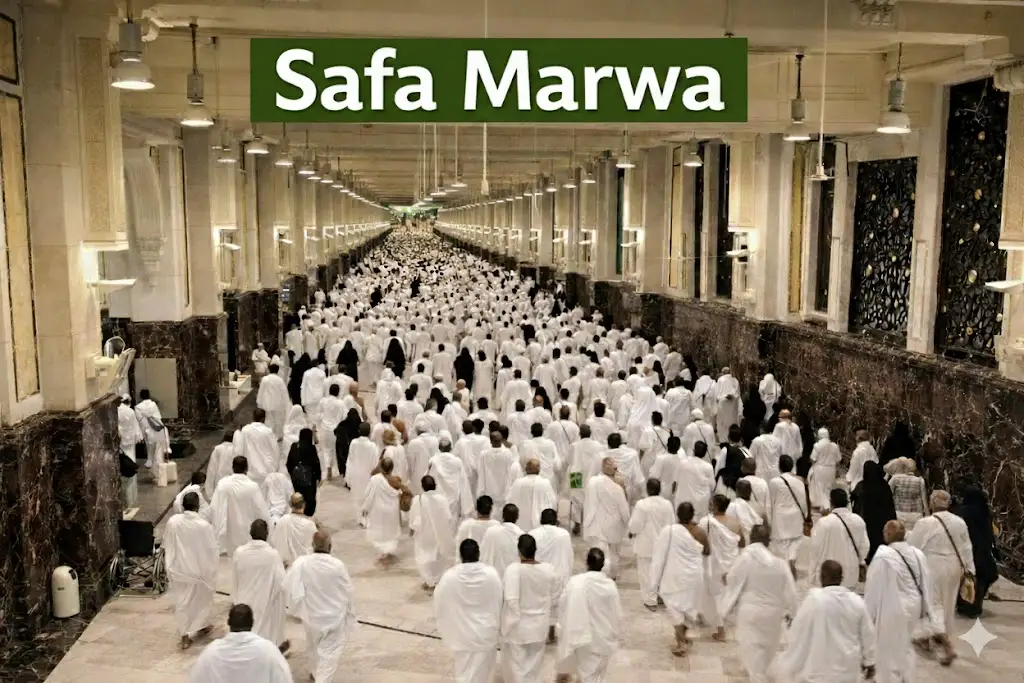
Safa and Marwa are two small hills within Masjid al-Haram in Makkah. During Hajj and Umrah, pilgrims perform Sa’i by walking between them seven times, starting at Safa and finishing at Marwa. This worship commemorates Hajar’s (AS) search for water for her son Ismail (AS) and reflects patience, trust, and Allah’s mercy.
If you’re planning Umrah from the U.S., it’s normal to feel a little nervous about Sa’i, especially when you hear different explanations online.
This guide helps you to learn about what Sa’i is, the Safa Marwa history behind it, why it matters, and the Safa and Marwa steps you’ll follow inside Masjid al-Haram. And yes, if you’re booking with an Umrah travel agency, these are exactly the basics your agency should explain clearly before you land.
What is Sa’i between Safa and Marwa?
Sa’i is a core Umrah rite performed after Tawaf. Think of it as worship through movement: you strive (like Hajar did), you make du’a, and you trust Allah for outcomes. If you’re booking an Umrah package from USA, your itinerary should include time and guidance for Sa’i, especially if you’re traveling with family or elders.
From a worship perspective, Sa’i is powerful because it combines two things Islam teaches repeatedly: striving is required, and results come from Allah. You move your feet, you make du’a, you stay patient, and you remember that the outcome is always in Allah’s hands.
Safa Marwa history: the story behind the rite
The Safa Marwa history is tied to the story of Hajar (AS). Prophet Ibrahim (AS), under Allah’s command, left Hajar and infant Ismail (AS) in the barren valley of Makkah. When the water ran out, Hajar (AS) searched desperately for help or water, moving between Safa and Marwa again and again. Then Allah sent Angel Jibril, and the blessed spring of Zamzam emerged near Ismail (AS). Sa’i preserves that memory as worship, so every pilgrim remembers what faith looks like when life feels impossible.
This is also why Sa’i isn’t just “walking.” It’s a symbol: a mother’s sacrifice, a believer’s effort, and Allah’s mercy arriving right when hope feels thin.
Why Safa and Marwa are important in Islam
1) They are named in the Qur’an
Allah says Safa and Marwa are among His symbols, and links walking between them to Hajj and Umrah. This is one of the clearest foundations for the rite.
2) The Prophet ﷺ showed how to begin
In the long narration of Jabir (RA), the Prophet ﷺ approached Safa and recited the verse, then said, “We will start with that with which Allah started,” and began at Safa. This wording is explicitly reported in Sunan an-Nasa’i (2962).
The same practice is also preserved in the detailed Hajj narration in Sahih Muslim (1218a), which describes how he began Sa’i from Safa.
3) It teaches real-life lessons (not just ritual steps)
Sa’i teaches patience in hardship, resilience under pressure, and trust in Allah while still taking action. That’s why many pilgrims say Sa’i feels emotional, because it connects worship to real human struggle.
Safa and Marwa steps: a simple walkthrough (Umrah)
Below are the Safa and Marwa steps in a practical, “do n’t-overthink-it” way. (Facilities and crowd flow may differ by level/floor, but the ritual itself is consistent.)
-
Start at Safa (after Tawaf)
After completing Tawaf (and drinking Zamzam if you’re able), follow the signs inside the Haram toward Safa. Nusuk notes that the original “mount” no longer exists in the same form, but its location is clearly marked, with remaining rocks visible on the ground floor and signs on upper floors.
-
Face the Ka‘bah and make du’a
At Safa, face the Qiblah/Ka‘bah direction, praise Allah, and make personal supplications. Many pilgrims keep it simple: gratitude, guidance, acceptance, and ease.
-
Walk from Safa toward Marwa (this counts as 1 when you reach Marwa)
Your first walk is Safa → Marwa. When you arrive at Marwa, that is one round complete.
-
Men: brisk walk/jog between the green markers (when safe)
Between Safa and Marwa, there is a marked section (often shown with green lights/markers). Classical explanations describe that this area historically represented a valley; men are encouraged to move faster there when able, without harming or pushing others. Women continue at a normal pace.
-
At Marwa, face the Ka‘bah and make du’a again
Pause, supplicate, then return.
-
Return Marwa → Safa (this becomes round 2 when you reach Safa)
Each arrival at an end point completes a count. Nusuk’s guidance is very clear: seven times total, starting from Safa and ending at Marwa.
-
Complete seven rounds, ending at Marwa
A simple way to remember:
- 1st ends at Marwa
- 2nd ends at Safa
…and the 7th ends at Marwa.
-
Distance (helpful for pacing):
The distance between Safa and Marwa is commonly cited as about 450 meters one-way, and completing the seven trips totals roughly 3.15 km.
Finish Umrah with hair trimming (Halq/Taqsir).
After Sa’i, men shave or trim the hair, and women trim a small portion to complete Umrah (according to common practice and scholarly guidance you follow).
Common mistakes U.S. pilgrims make (and easy fixes)
The biggest issue is losing count, especially if you’re tired or walking with family. A simple fix is to only count when you reach Safa or Marwa, not while you’re in the middle. Another common mistake is starting from Marwa; remember the Sunnah: begin at Safa.
If you’re going with family on an Umrah package from USA, decide one small “system” before you enter the Sa’i area: who counts, where you regroup if separated, and whether you’ll do Sa’i on the ground floor or upper level.
Choosing the right support!!
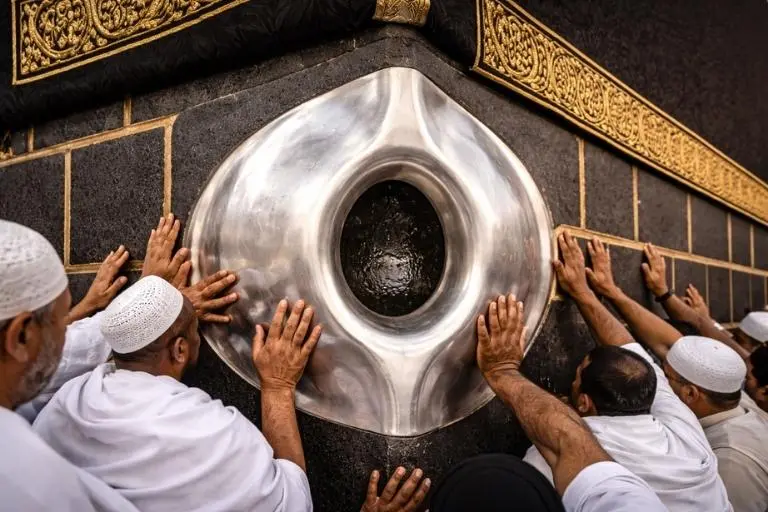
If you’re considering seasonal December or Ramadan Umrah packages in 2026, plan for heavier crowds and slower movement. Sa’i can take longer, and family coordination matters more. This is one reason choosing a reliable Umrah travel agency like Alhadi Travel helps you stay informed about Sa’i timing, the best entry points, and how to keep your group together without stress. Before you travel, many pilgrims also like learning about key landmarks inside the Haram. See our guide on Hajre Aswad in Islam.
And if you’re searching Umrah travel agency near me in the U.S., one smart question to ask is: “Will you guide us through Tawaf and Sa’i clearly, including counting and the green-marker section?” A good agency answers calmly and specifically, not vaguely.