
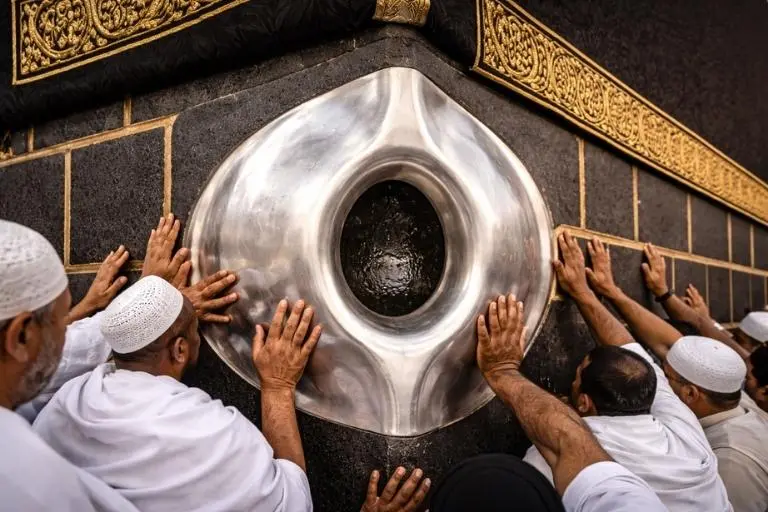
For many Muslims, the first time they hear about the Hajre Aswad (Black Stone) in detail is when they start looking into Umrah trips or comparing Umrah packages from the USA. Friends and family say, “Make sure you try to touch it,” and you see images of crowds stretching their hands towards one corner of the Kaaba. It all feels important, but also a little unclear. What exactly is this stone? Why do millions of people long just to get close to it?
In Islam, the Hajre Aswad is not a symbol of superstition or something to be worshipped. It is a blessed stone, placed in the eastern corner of the Kaaba, and it marks the point where each round of Tawaf begins and ends.
In this article, we will look at the history of the Black Stone, its role in Hajj and Umrah, and how understanding its true significance before performing Umrah can bring greater heart and focus to your journey.
What Is the Black Stone of Kaaba?
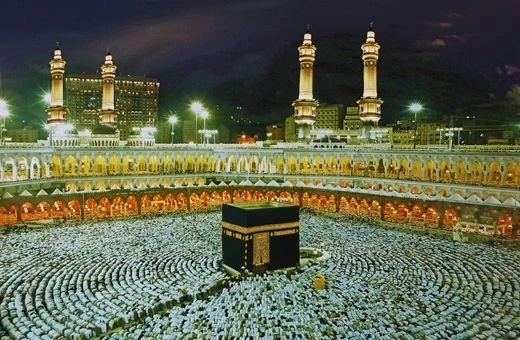
The Black Stone of Kaaba (Hajre Aswad) is a sacred stone set into the eastern corner of the Kaaba in Masjid al-Haram, Makkah. It sits about chest height, surrounded by a silver frame, and today appears as several dark fragments joined together.
For every pilgrim, this stone plays a clear practical role. It marks the point where each circuit of Tawaf begins and ends. When you walk seven times around the Kaaba, you face the Black Stone at the start of every round.
Islamic teaching is very clear: Muslims do not worship the stone. It does not have the power to harm or benefit anyone by itself. Its value lies in its history, its link to the Prophets, and in copying the actions of the Prophet Muhammad ﷺ. This is the heart of the Importance of Hajre Aswad: it is a symbol of faith and obedience, not an object of worship.
Heavenly Origins and Early History!!
Hajre Aswad is not an ordinary rock. It was sent down from Paradise and given to Prophet Ibrahim (Abraham) and his son Ismail (Ishmael) when they were building the Kaaba by Allah’s command.
The stone was originally “whiter than milk”. With time, it became black because of the sins of the children of Adam who touched it.
When Ibrahim (AS) and Ismail (AS) raised the foundations of the Kaaba, the Angel Jibreel (Gabriel) brought this stone to be placed in one special corner. Since then, the Black Stone of the Kaaba has been a physical reminder that this House is tied to divine guidance and the message of pure monotheism.
The Prophet Muhammad ﷺ and the Black Stone
-
The Quraysh Dispute and the Cloth
Around 605 CE, before he became a Prophet, Muhammad ﷺ faced a major conflict in Makkah. The Quraysh tribe rebuilt the Kaaba after damage from a flood and fire. When it was time to return the Black Stone to its place, each clan wanted the honour. The argument nearly led to fighting.
Muhammad ﷺ, known as Al-Amin (the Trustworthy), suggested a wise solution. He asked for a cloth, placed the stone in the middle, and asked one leader from each clan to hold a corner of the cloth. Together, they lifted it to the wall. Then he placed it into position with his own hands.
This moment shows another side of the Importance of Hajre Aswad: it became a symbol of unity and justice, not division.
-
During and After Prophethood
Later, as a Prophet, Muhammad ﷺ continued to honour the stone. During Tawaf, he would touch or kiss it when able, and when the area was crowded, he would touch it with a stick and kiss the stick.
When Makkah was peacefully conquered in 630 CE, he performed Tawaf and again showed respect to Hajj-e-Aswad, but also cleared the Kaaba of idols, making it a pure place of worship for Allah alone.
What Do Muslims Believe About the Stone?
-
Sunnah to Kiss or Touch
The Prophet ﷺ taught by action. Pilgrims try to kiss or touch Hajre Aswad in Tawaf because he did so, not because the stone itself has power. Many scholars describe this as a special act of worship where a person shows love for Allah by following the Sunnah exactly.
When crowds are heavy, it is also Sunnah to simply point towards the Black Stone of Kaaba and say “Allahu Akbar.” This keeps worship safe and calm.
-
Umar’s Famous Statement
Sayyiduna Umar ibn al-Khattab (RA) gave us a clear way to understand the Importance of Hajre Aswad. He kissed the stone and said:
“I know that you are a stone and can neither benefit nor harm anyone. Had I not seen the Messenger of Allah ﷺ kissing you, I would not have kissed you.”
His words are recited in almost every serious discussion of the Black Stone. They protect Muslims from wrong beliefs and keep everything focused on Allah alone.
-
Expiation of Sins and Testimony
Several hadith mention that touching or kissing the Black Stone and another Yemeni corner of the Kaaba is a cause for sins to be wiped away.
Other narrations say that on the Day of Judgment, the stone will be given a tongue and eyes and will bear witness for those who approached it with sincere faith.
So the stone becomes a symbol of covenant: a reminder that your heart, tongue, and body are all in allegiance to Allah. This is one of the deepest layers in the History of Black Stone.
Damage, Theft, and Protection Through the Ages
In early centuries, the Black Stone was one whole rock. Over time, war and disasters damaged it. During a siege in 683 CE, it was struck and broken by stones from a catapult. The pieces were later fixed together with support.
In 930 CE, a radical group called the Qarmatians attacked Makkah and stole the stone. They took it away to their base in the Gulf region and kept it for around 20–22 years before it was finally returned to the Kaaba in 952 CE.
Because of this history, the Hajre Aswad today is made up of several dark fragments held together in a silver casing fixed to the corner of the Kaaba, measuring roughly 20cm by 16cm on its visible surface.
How Understanding Hajre Aswad Enriches Your Umrah?
When you know the History of Black Stone and the real Importance of Hajre Aswad, your first sight of it is very different. You do not see “just a stone” or a crowd to fight through. You see:
- A sign of Allah’s mercy and forgiveness
- A link to Ibrahim (AS), Ismail (AS), and Muhammad ﷺ
- A reminder that your heart must stay pure from shirk and filled with sincere tawbah
For Muslims in the USA, a well-planned Umrah can be life-changing. With the right Umrah Trips, careful advance Umrah Booking, and clear guidance, you can focus on dua, reflection, and family, instead of only trying to “get a kiss” of the stone at any cost.
Alhadi Travel aims to support that kind of balanced, spiritual journey, from flight planning and hotel choice to on-the-ground guidance in Makkah and Madinah.
If you want to learn more about visiting the Black Stone of Kaaba the correct way and preparing your heart before you travel, contact Alhadi Travel to discuss tailored Umrah Packages from the USA that fit your family, your schedule, and your level of experience.