
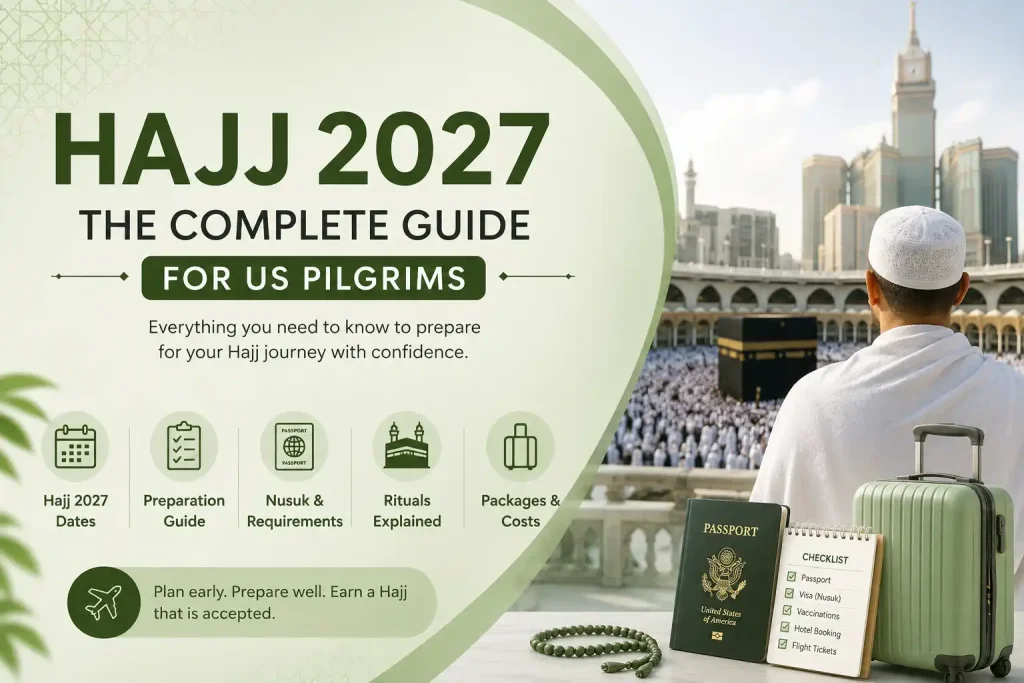
You’ve decided to answer the call of Hajj. That’s not a small thing. It’s a milestone most Muslims spend years working toward, and now you’re one step closer. But getting from a decision in Chicago, Houston, or Los Angeles to actually standing before the Kaaba takes more than a plane ticket. It takes real preparation, paperwork, planning, and a shift in how you see the months ahead.
Hajj is the fifth pillar of Islam. It’s not a vacation, and it was never meant to feel like one. At Alhadi Travel US, we’ve spent years walking American pilgrims through this exact journey, so we know where people get stuck. Our job is simple: handle the logistics so you can focus on the worship.
What Is Hajj?
Hajj means “to set out toward a place.” In Islamic terms, it’s the pilgrimage to the Kaaba in Makkah during Dhul Hijjah, done the way the Prophet Muhammad (ﷺ) taught his companions to do it. It holds a central place in Islam.
The Prophet Muhammad (ﷺ) said:
“Islam is built upon five”: testifying that there is no god but Allah and that Muhammad is His Messenger, establishing prayer, giving Zakat, performing Hajj, and fasting Ramadan.
(Sahih al-Bukhari 8; Sahih Muslim 16)
Picture this: millions of people, from every country and background, standing in Makkah, Mina, Arafah, and Muzdalifah at the same time. All of them in the same plain white garments, called Ihram. A president and a shopkeeper look identical out there. Nobody’s title matters. Everyone repeats the same words, Labbaik Allahumma Labbaik, and for a few days, wealth and status simply disappear.
The journey retraces the steps of Prophet Ibrahim (AS), His wife Hajar (AS) and their son Ismail (AS). Muslims believe a sincere Hajj wipes the slate clean.
As the Prophet (ﷺ) put it:
“Whoever performs Hajj for the sake of Allah and does not commit any obscenity or transgression will return as the day his mother bore him.”
(Sahih al-Bukhari 1521, Sahih Muslim 1350)
Who Must Perform Hajj?
Islamic law lays out five conditions. All five have to be true before Hajj becomes obligatory for you:
- Islam. You practice the faith, the foundation everything else builds on.
- Adulthood. You’ve reached maturity; Hajj isn’t required of children.
- Sound mind. You really understand what you’re undertaking and can carry it out.
- Physical ability. Your body needs to handle long walks, desert heat, and packed days with little rest.
- Financial ability (Istita’ah). You can afford the trip without debt, and without leaving your family short at home. This one trips people up more than they expect.
Meet all five, and Hajj becomes a duty you owe once in your life. Scholars encourage doing it as soon as you’re able. Waiting doesn’t make it easier.
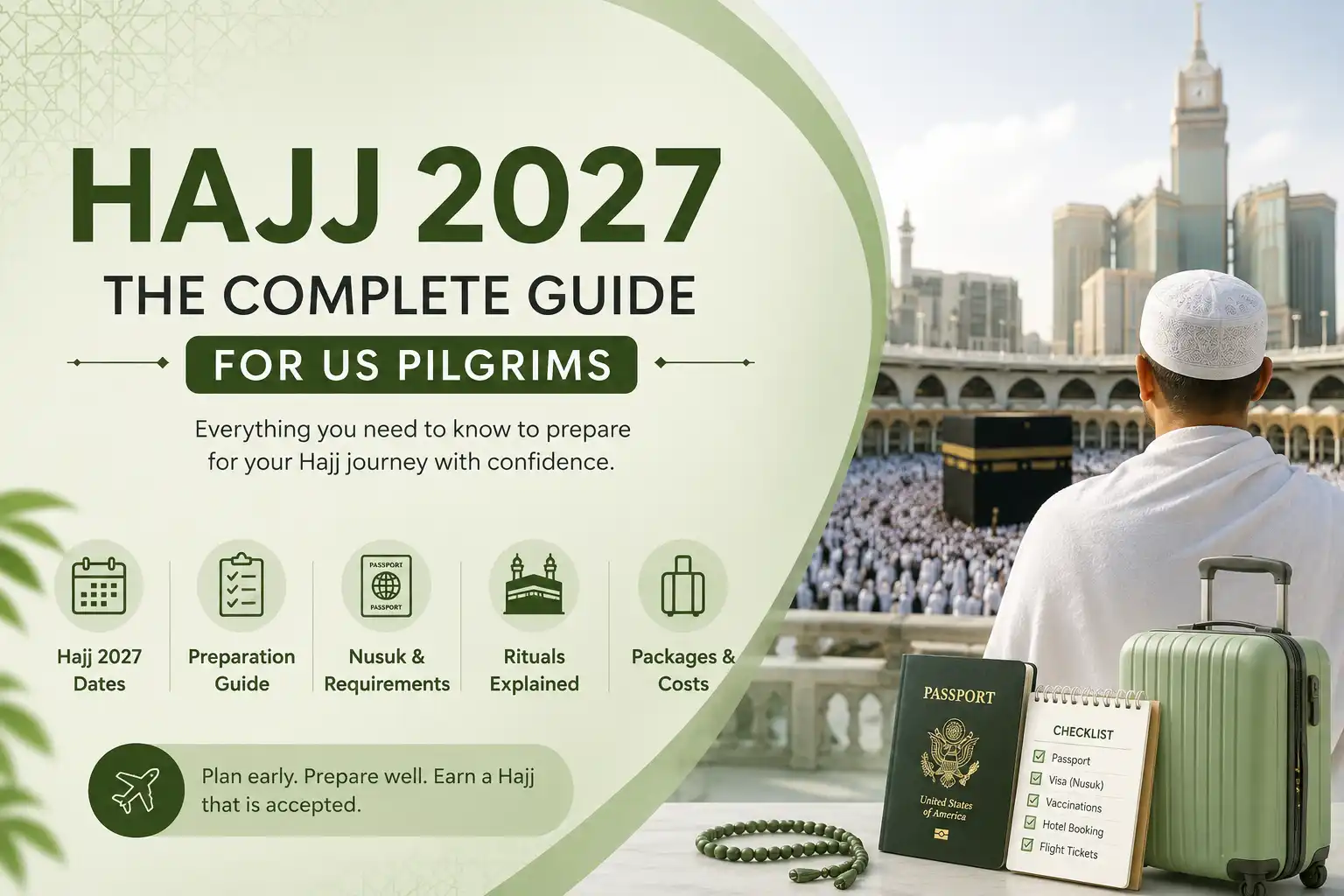
When Is Hajj 2027?
Here’s the thing about the Islamic calendar. It follows the moon, so the dates shift roughly 10 to 11 days earlier every Gregorian year. That means Hajj 2027 is expected to land in late May or early June 2027. Saudi authorities won’t lock in the exact dates until closer to the season, once the moon sighting confirms it.
What you can count on:
- Core rituals run from the 8th through the 13th of Dhul Hijjah.
- Day of Arafah, the spiritual center of the whole pilgrimage, falls on the 9th.
- Eid al-Adha falls on the 10th.
Saudi Arabia limits how many pilgrims each country can send each year. That quota is exactly why booking early matters so much for US pilgrims: it’s the difference between a hotel two minutes from the Haram and one that’s a forty-minute bus ride away.
How to Prepare for Hajj
Preparation breaks down into three parts: your heart, your paperwork, and your body. Skip one, and the trip gets harder than it needs to be.
Prepare Your Heart
Start here, because everything else depends on it.
- Set a sincere intention. Make sure this is for Allah, not for the photos or the story you’ll tell afterward.
- Learn the rituals before you fly. Don’t plan on figuring it out once you land.
- Memorize your duas. Get the supplications for Arafah, Muzdalifah, and Tawaf down cold, well before departure.
- Settle your affairs. Pay off debts. Ask forgiveness from anyone you’ve wronged. Update your will if you haven’t already.
- Build patience now. Extra prayer, fasting, and Qur’an recitation in the months beforehand make the crowds and the heat far more bearable later.
Prepare Your Paperwork
- Your passport needs at least six months of validity left past your return date. Check it now, not the week before.
- Keep both digital and printed copies of your ID, booking confirmations, and hotel vouchers.
- See your doctor for a full medical checkup before you travel.
- Complete every required Saudi immunization early. Some take weeks to become effective.
Prepare Your Body
You’ll be walking more than you think. A lot more.
- Start walking daily, months in advance. Hajj means miles on foot, often in serious heat.
- Pack light. Breathable clothing, unscented toiletries, a prayer rug, and a portable power bank cover most of what you’ll need.
- Budget for extras: personal spending, charity, and the animal sacrifice (Qurbani) all add up.
Your Hajj Preparation Timeline
Spreading this out over several months beats cramming it all into the final weeks. Here’s roughly how it should go.
- 12 months out: Figure out your budget first. That number shapes almost every choice after it. Then start looking at hajj packages from the USA and comparing a few agencies before you settle on one. If your passport expires within a year of travel, renew it now.
- 9 months out: Register on Nusuk. Lock in your package, flight, and hotel tier. Start reading through the rituals in order so nothing feels unfamiliar later.
- 6 months out: Book your medical checkup and vaccinations. Begin walking daily, even twenty minutes builds real stamina over time. Start setting aside cash for Qurbani and spending money.
- 3 months out: Attend any pre-Hajj seminars your agency runs. Memorize your duas for Arafah, Muzdalifah and Tawaf. Settle debts and personal disputes.
- 1 month out: Confirm flight times and hotel vouchers. Pack your bags. Lay out your passport, visa, and vaccination card side by side and double-check everything.
- 1 week out: Reconfirm pickup times with your group leader. Charge your power banks. Pack a small carry-on with medication, documents, and your Ihram garments. And take a moment: call your family, ask for their duas, make peace with anyone you’ve had a falling out with.
Common Mistakes First-Time Pilgrims Make
We see the same handful of avoidable problems trip people up every single year.
- Packing too much. You’ll be carrying your own bag through crowds for miles. Pack light. Leave room, you’ll buy things in Makkah anyway.
- Skipping the walking practice. Tawaf and Sa’i alone cover several miles. Pilgrims who never trained for it often struggle badly by day three.
- Not learning the duas ahead of time. Trying to read supplications off a booklet while standing in a crowd of a million people is genuinely hard. Memorize the key ones before you leave home.
- Underestimating the heat. Dhul Hijjah often lands during intense heat. Drink water constantly, even before you feel thirsty, and carry an umbrella for Tawaf and Arafah.
- Losing your group. Crowds during Hajj can reach into the millions. Save your group leader’s number. Memorize your hotel’s name. Agree on a meeting point in case you get separated, because it happens more than you’d expect.
- Booking too late. Quotas fill fast. The best rooms near the Haram go to whoever reserves first, not whoever plans best.
Traveling With Elderly or Disabled Pilgrims
Age, or a physical limitation, doesn’t rule out Hajj. With the right plan in place, older pilgrims and those needing extra support complete the journey safely every year.
- Arrange mobility help. Wheelchairs and push services are available for Tawaf and Sa’i.
- Pack enough medication, along with clear prescriptions from your doctor.
- Travel with support. Bring a family member, or choose a package (like the ones Alhadi Travel US offers) that includes dedicated helper assistance.
Nusuk Hajj: What US Pilgrims Need to Know
Saudi Arabia’s Ministry of Hajj and Umrah now handles registration for Western countries through the Nusuk platform. Here’s how it actually works.
- Create your account. Register with a valid email, your full legal name, and your nationality details.
- Gather your documents. You’ll need a US passport valid for at least six more months, a passport-style photo on a plain white background and proof of US citizenship or legal residency.
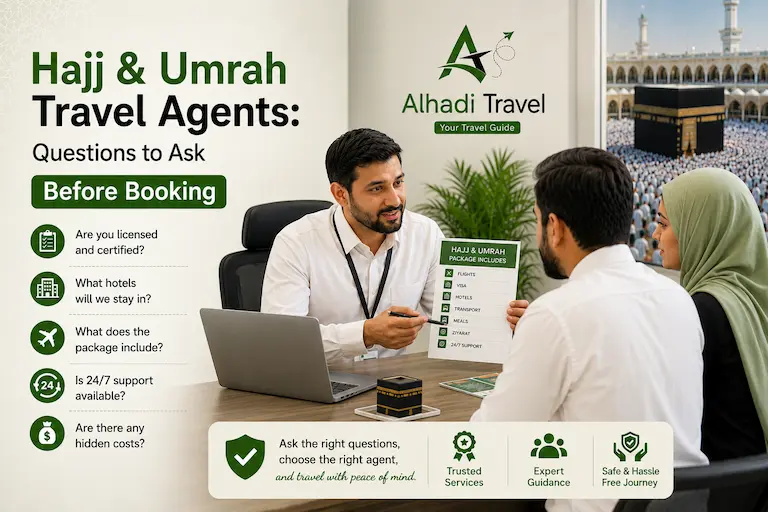
- Choose your package. Once your profile clears verification, you can compare hotel tiers, Mina camp upgrades, and transport options from authorized providers. Going through a licensed agency, Alhadi Travel US, for example, means you don’t end up overpaying or under-planning without realizing it until you’re already there.
- Handle your visa and health requirements. You need an official Hajj visa. Entering without one carries serious penalties, no exceptions. You’ll also need to meet Saudi Arabia’s current vaccination requirements before you fly.
What Happens After You Book
The moment you reserve, you’ll get a confirmation email and a welcome packet: nothing fancy, just the basics you need to know you’re locked in.
From there, our team gets to work verifying your Nusuk profile and documents. If anything’s missing or off, we’ll flag it early, not two weeks before your flight when there’s no time to fix it.
You’ll also be invited to a few pre-Hajj webinars. These cover the rituals in order, plus the practical stuff: what to pack, what to expect at the airport, how the group system works once you land. Alongside that, you get a written ritual guide and a packing checklist to keep for reference.
As your departure date gets closer, we send over your flight tickets, hotel details, and your group leader’s contact information. And once that’s done, our support line stays open. Day or night, someone’s reachable until you’re actually on the plane.
The Rituals of Hajj, Step by Step
It starts with Ihram. At a designated boundary point, you enter a state of purity: the white garments go on, and from that moment, your focus shifts entirely to worship.
Once you reach Makkah, you perform Tawaf, circling the Kaaba seven times in a counterclockwise direction. Right after, there’s Sa’i: walking briskly seven times between the hills of Safa and Marwah, retracing Hajar’s search for water.
On the 8th of Dhul Hijjah, you head to Mina, the tent city outside Makkah, where you spend the day in prayer and quiet reflection ahead of what’s coming next.
The next day is the big one. Arafah is where you stand in supplication on the open plains, and it’s the emotional core of the entire pilgrimage. The Prophet (ﷺ) put it plainly: “Hajj is Arafah” (Sunan an-Nasa’i 3016, also narrated in Sunan Abi Dawud, Jami’ at-Tirmidhi, and Sunan Ibn Majah). Nothing else in Hajj carries quite the same weight as this one afternoon.
From Arafah, you move to Muzdalifah for the night, sleeping under the open sky and gathering pebbles you’ll need the next day. Those pebbles get used at the Jamarat, where you throw them at three pillars symbolizing temptation.
Around this same time comes the sacrifice, or Hady, an animal offered in remembrance of Ibrahim’s devotion to Allah, the same devotion this entire journey is built around.
Then you return to Makkah for Tawaf al-Ifadah, the obligatory circuit around the Kaaba that completes the core of Hajj. And before you finally head home, there’s one more circuit: the Farewell Tawaf, a last few moments with the Kaaba before you say goodbye.
If you want all steps in detail click on this: 7 steps of the Hajj
Which Type of Hajj Should You Choose?
- Hajj al-Tamattu. Perform Umrah first, exit Ihram, then re-enter it for Hajj on the 8th of Dhul Hijjah. Most international pilgrims go this route.
- Hajj al-Qiran. Combine Umrah and Hajj under one continuous state of Ihram.
- Hajj al-Ifrad. Enter Ihram for Hajj alone, and stay in it until Eid.
What’s Included in a Hajj Package From the USA
A solid package should cover round-trip flights from major US airports, hotels near the Haram in both Makkah and Madinah, air-conditioned bus transfers between sites, full visa processing, English-language scholarly guidance throughout the trip, round-the-clock on-ground support, and room setups built for families traveling across generations.
Hajj Cost From the USA: What Actually Drives the Price
Three things mostly decide what you’ll pay. Hotel distance from the Haram is the biggest one: rooms facing the mosque cost far more than ones out in Aziziyah. Package tier matters too: better Mina camps, upgraded bedding, and improved catering all push the price up. And travel dates shift airfare depending on the season and how far ahead you book.
Alhadi Travel US gives you an itemized quote up front. No surprise fees later, no vague line items you have to ask about.
Why Pilgrims Choose Alhadi Travel US
We’ve spent years running international Hajj trips for American Muslims. Our support team is US-based and works in your time zone, no waiting overnight for a reply. Scholars travel with the group and answer questions on the ground, in real time. And we build in extra care for first-time pilgrims, seniors, and families from the start, not as an afterthought.
Book Early for Hajj 2027
Quotas fill. Hotel rooms near the Haram go first. The earlier you book, the better your options, and the more time you’ll have to actually prepare, instead of scrambling.
Contact Alhadi Travel US today to reserve your place for Hajj 2027.
Standing before the Kaaba. Weeping at Arafah. The quiet of the Prophet’s Mosque late at night. These are the moments that stay with you for the rest of your life. Hajj is your chance to start over, completely clean.